
// ARTICLE
Tres Pinatas maths, step by step
The configurations, the hit rate, the price of each door and what the ceiling is worth at your stake.
RTP is return to player: the share of all stakes a game pays back across its lifetime. Tres Pinatas Hold & Win by Hacksaw Gaming publishes four of them, plus three more for its purchase paths. This page puts every one of them at your stake.
Four published configurations#
The game ships in four RTP tiers and the casino chooses which one it runs. That sounds like a complication; in practice it is the single most useful thing to know before you deposit anywhere, because the gap between the top and the bottom tier is about ten percentage points of return.
| Configuration | Return | What it means for your session |
|---|---|---|
| Observed build | 96.26% | The tier running in the free demo on this site, measured over 10,000,000,000 simulated rounds |
| Second tier | 94.30% | Just under two points below the top build, on identical rules and identical jackpots |
| Third tier | 92.32% | Just under four points below the top build; the same 2,500x ceiling still stands |
| Fourth tier | 86.29% | The lowest published tier; worth checking for before a long session |
Nothing else changes between the tiers. The grid stays 5 reels x 3 rows, the nine lines still pay left to right from the leftmost reel, the Piñata Party still runs on three refilling lives, and the jackpot ladder still tops out at 2,500x. Only the long-run return moves.
Finding yours takes ten seconds, and it pays to make a habit of it. Open the game through the button on this page, tap the menu, open GAME INFO, and the return is printed on the rules page alongside the paytable. Do it once at every new casino, before the first spin rather than after the fiftieth.
Volatility and how often the reels answer#
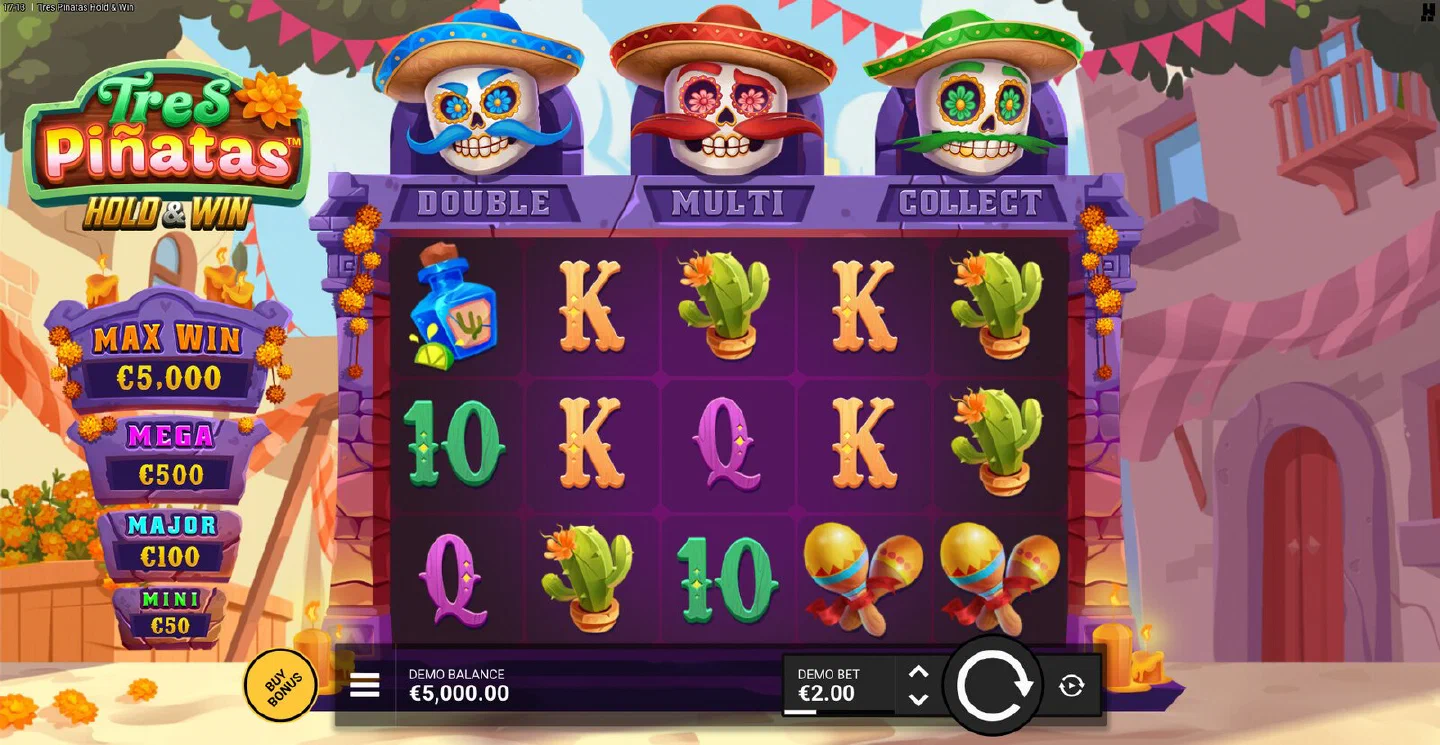
The volatility meter on the intro splash reads 3 / 5, and the label attached to it is Medium. That is the middle of the scale, and the hit rate explains what the middle feels like: a win lands on about 41.68% of spins, roughly two spins in five.
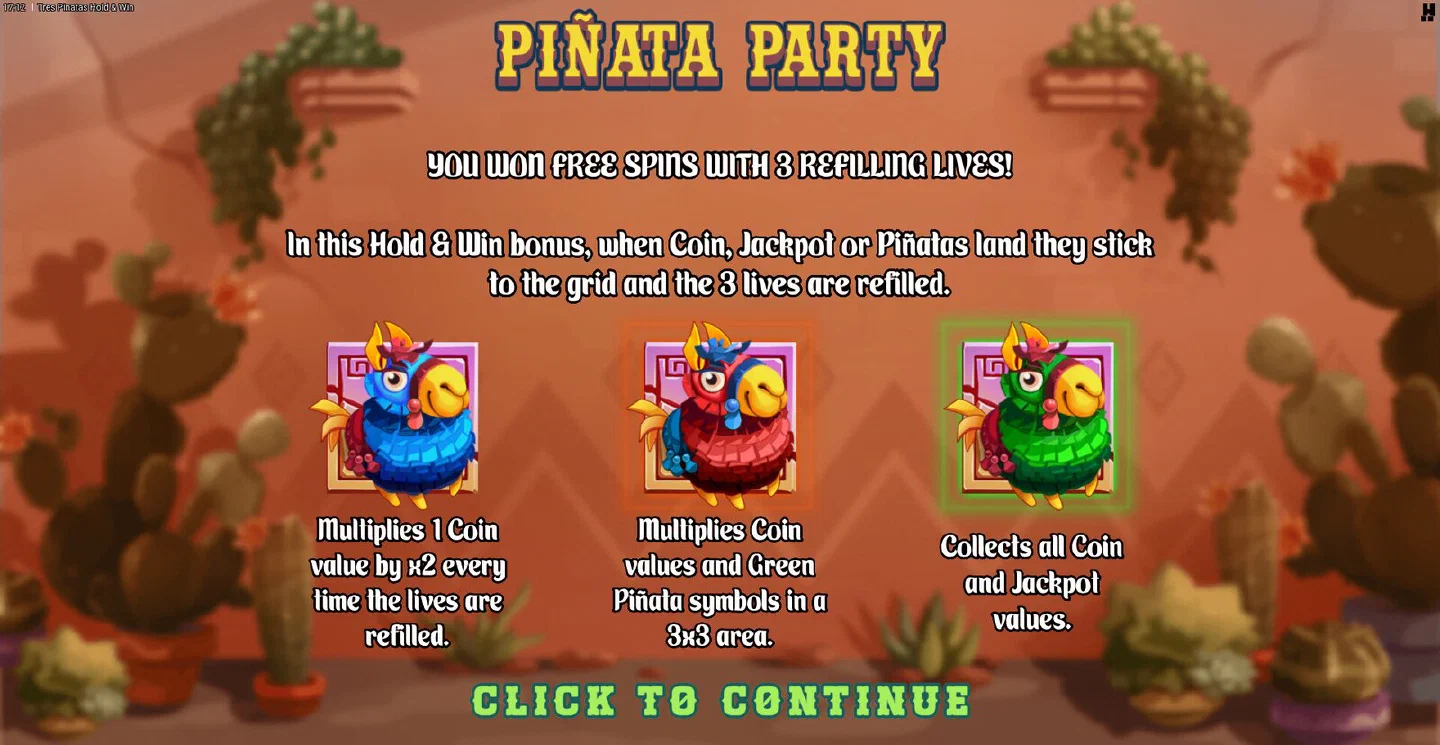
Those two figures describe the same behaviour from different angles. The base game has no feature of its own, so every one of those wins is a line win or a Wild-assisted one, and the top line pays 10x the stake for five guitars. Small, frequent, and enough to keep a balance moving while the Skulls fill. Then the Piñata Party arrives and the distribution changes completely: three lives, sticky Coins from 1x to 500x, and a ceiling at 2,500x.
For a player, the practical reading is simple. This is a game that pays in instalments and saves its drama for one room, so the stake matters less than holding it steady: a 3 / 5 profile with a 41.68% hit rate gives you nothing for doubling up after a quiet run. Five guitars pay 10x whether the spin before them paid or not. The strategy page turns that into a session plan with numbers attached.
The bet range and what each purchase costs#
The ladder runs from €0.10 to €400.00 a spin, which is a very wide range for a nine-line game and the reason the same title suits a careful evening and a fast one. Every purchase price is a multiple of that stake, so the three doors into the bonus cost whatever your own step makes them cost.
| Path | Price | At €0.10 | At a €2 stake | At €400.00 | Published RTP |
|---|---|---|---|---|---|
| BonusHunt FeatureSpins | 5x the stake per spin | €0.50 | €10 | €2,000 | 96.28% |
| Mini Piñata Party | 100x the stake | €10 | €200 | €40,000 | 96.28% |
| Mega Piñata Party | 200x the stake | €20 | €400 | €80,000 | 96.34% |
Three things fall out of that table. First, FeatureSpins is a per-spin price rather than a one-off: the mode stays active until you switch it off, and each spin at 5x the stake is ten times likelier to open the bonus than a normal one. Second, Mini at 100x and Mega at 200x are one-off entries, and Mega costs exactly twice Mini. What the extra buys is the guarantee: Mini starts you with 1 to 3 Piñatas on the grid, Mega with 2 to 3.
Third, and most useful, the published returns go up rather than down. The observed base build pays 96.26%; both cheaper doors publish 96.28% and Mega publishes 96.34%, the highest figure in the game. Paying for the room here costs you money, never return. Mega’s 96.34% sits 0.08 points above the observed base build rather than below it. The BONUS BUY panel opens at the casinos that offer it: the BUY BONUS control sits in the row under the reels, and SHIFT+B opens the same panel from the keyboard.
The ceiling and the jackpot ladder#
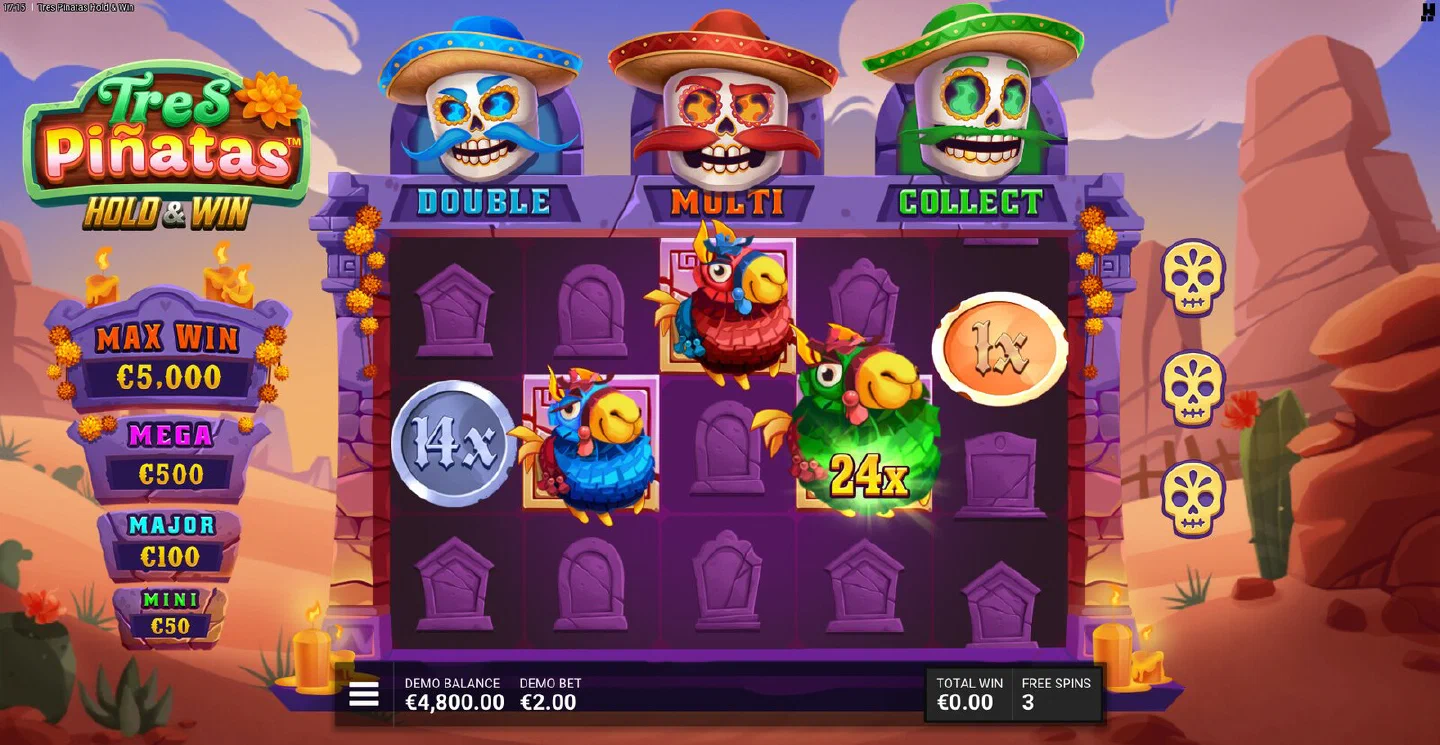
One round can pay 2,500x the bet, and that ceiling is live in every bonus mode: the naturally triggered Piñata Party, FeatureSpins, Mini and Mega alike. Below it sit four fixed jackpots, which land as Jackpot symbols inside the bonus and are multipliers of your stake rather than a shared progressive pool.
| Rung | Multiplier | At €0.10 | At a €2 stake | At €400.00 |
|---|---|---|---|---|
| Mini | 25x | €2.50 | €50 | €10,000 |
| Major | 50x | €5 | €100 | €20,000 |
| Mega | 250x | €25 | €500 | €100,000 |
| Max Win | 2,500x | €250 | €5,000 | €1,000,000 |
The Coin ladder underneath them is what fills the grid between jackpots: bronze at 1x, 2x, 3x and 4x, silver at 5x, 6x, 7x, 8x, 9x and 10x, gold at 20x, 30x, 40x and 50x, and diamond at 100x, 150x, 250x and 500x. Note where those ranges overlap the jackpots. A gold Coin at 50x matches the Major rung exactly. A diamond at 250x matches the Mega. A single diamond at 500x is twice the Mega and one fifth of the entire ceiling.
That overlap is how a 2,500x round is assembled, and the arithmetic is worth setting out. Five diamonds at 500x make the ceiling exactly. A more ordinary board gets close on eight of the fifteen cells: one diamond at 500x carried to 1,000x by a Blue refill, a second diamond at 500x, the Mega at 250x and five gold Coins at 50x add up to 2,000x, leaving the last 500x to a Green restart or a Red. A Red that catches a 3x3 corner holding four gold 50x Coins turns 200x into anything from 400x to 2,000x in a single resolution, and it leaves the Jackpot values where they are. The features page walks each path symbol by symbol.
What the base game contributes#
A published return is one number covering two very different halves of the game, and separating them makes the figure easier to use.
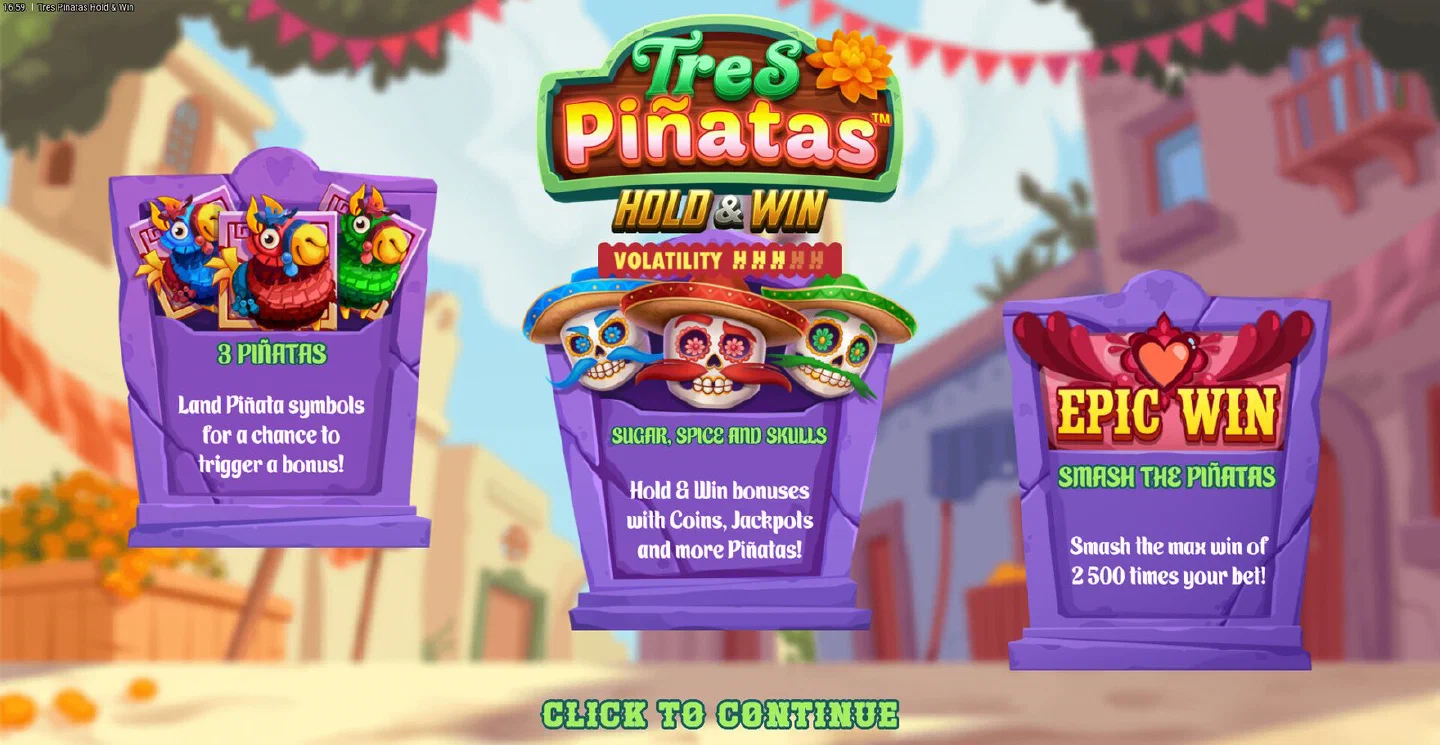
The base game is the frequent half. Nine lines, a Wild that substitutes for every symbol in the paytable, and a top line win of 10x the stake for five guitars. That top win is worth €1 at a €0.10 spin, €20 at a €2 spin and €4,000 at the €400.00 maximum. Wins arrive on about 41.68% of spins, and none of them is large by design: this half of the game exists to keep a balance moving while the three Skulls fill.
The bonus is the loaded half. Coins carry 1x to 500x, four jackpots sit at 25x, 50x, 250x and 2,500x, and three colours multiply or collect what is already on the board. Every value there is bigger than the entire base-game paytable, and the ceiling is 250 times the best line win in the game.
| Event | Multiplier | At €0.10 | At a €2 stake | At €400.00 |
|---|---|---|---|---|
| Five guitars on a line | 10x | €1 | €20 | €4,000 |
| A single gold Coin | 50x | €5 | €100 | €20,000 |
| A single diamond Coin | 500x | €50 | €1,000 | €200,000 |
| The round ceiling | 2,500x | €250 | €5,000 | €1,000,000 |
Read down that table and the structure of the return becomes obvious. The frequent half pays in single euros at a small stake; the loaded half pays in multiples of a hundred. A 96.26% return is the sum of both, which is why a session that never reaches a bonus feels nothing like the published figure, and why one that does can leave it far behind for an evening. The features page covers what lands in that second half.
Reading these numbers without fooling yourself#
The 96.26% figure was measured across 10,000,000,000 simulated rounds. No player covers a distance like that, which is the entire point of it: the percentage is a property of the machine, measured over a sample no evening can approach. It is not a forecast for the session in front of you, and the four published tiers are the part of it you can actually act on.
What you do control is the stake, the pace and the stopping point. AUTOPLAY, at the operators that offer it, takes a number of rounds along with a total session loss limit and a single win limit, and those two limits are the part actually worth setting. History lets you read back completed rounds afterwards, which is the honest way to check what a session really did rather than what it felt like.
So use the numbers on this page as tools. Pick the table running the highest configuration you can find, set a step on the ladder and leave it there, decide in advance which of the three doors you would pay for at that step, and let the 3 / 5 profile do what it does. Then read the review for the verdict, the hub page for everything else about the game, or compare it with Great Game Serengeti if you want a second Hacksaw frame beside this one.
18+. The published return is a long-run property of Tres Pinatas Hold & Win and never a forecast for one session. Set your limits first, and the responsible gambling page shows how.